
Women & Change
Synopsis and Inquiry
From Personal Hot Flush to Cross-Cultural Research
When I was 42, I started feeling bodily changes so far unknown to me. My gut instinct told me I was entering the menopausal process. This inner feeling of change did not find a space to be seen or heard in the outside world. For years, I somehow “soldiered” on, until I could no more. The turning point came, when I decided that I didn’t want to suffer anymore. I became determined to find out how to live my menopausal process as something empowering and enjoyable.
Through an older female friend, I discovered the classic Menopausal Years: The Wise Woman Way by Susun S. Weed. This book was key to my actively shifting away from the mainstream reductionist medicalized discourse on menopause and towards understanding and experiencing the Change as a phase of unique aliveness and an ancient and sacred rite of passage.
I learned which herbal remedies are relevant to the symptoms and ailments that can come with menopause, and my physical state improved. Together with a friend, also in the central years of the menopausal transition, we started a group for menopausing women to regularly come together and share our stories and experiences – highly liberating and recommended.
At the same time, I launched into reading anthropological and medical literature about the different cultural perspectives on menopause and (female) ageing. With the support of a journalist’ stipend from the Stiftung Mensch und Mensch (Human to Human Foundation) in Berlin, I then began interviewing and offering workshops around the menopausal Change in Brazil, Mexico, Germany and Spain.
Appreciating the Menopausal Process in a New Light
Hearing the different stories across four countries confirmed and showcased how each menopausal (or andropausal, so male body Change process) process is three things: unique to that specific body, formed by the person’s life history, and shaped by their cultural norms. Each Change is a mix of what is universal, personal, and contextual. The stories, echoed by medical anthropology and evolutionary science, highlight the importance and impact of how cultural perspectives and opinions shape, limit, or enrich menopausal (or andropausal) experiences. At the same time, they show how our personal attitude towards the Change is key to how we experience this life phase and our process of ageing.
This fascinating research was intended to become a short journalistic piece, and ended up becoming a longer report, which is now available as E-book and print, in English and German (see below). I’m looking to offer a Spanish and Portuguese translation, so all those in Brazil, Mexico and Spain who shared their stories can also read the report.
Questions from the Report
With my work, I aim to raise interest for socio-political transformation, such as the following questions:
Do we want women to suffer unnecessarily, because they buy into scary mainstream medical narratives; or to live this period of their lives in a joyful and empowered way?
What would our societies look like, if we accept and take seriously Change processes as personal and societal portals towards elderhood and transgenerational wisdom?
How can 21st century entrepreneurs, pharmaceutical companies, and shareholders take the diversity and uniqueness of bodily experiences into account as a fact of economics?
The Report:
Menopause – Listening Across Cultures
What if menopause were not an ending, but a beginning?
(Available in English and German editions)
Travelling through Brazil, Mexico, Germany and Spain during 2024-2025, I gathered stories from midwives, elders, scientists, artists, dancers, and everyday women to illuminate menopause as a richly human and deeply cultural experience.
The book draws on these more than a hundred conversations and workshops, in health clinics in Bahia, midwife encounters in Oaxaca, and community circles in Barcelona and Stuttgart, to explore the Change as a portal shaped by food, ancestry, language and the Earth’s wider rhythms. Blending academic research with storytelling, it offers readers a different way of understanding menopause: not as decline, but as creative fire – an ancient inheritance that reconnects us to intuition, desire and the wisdom of community.
Moving, transformative, and fiercely encouraging, this book invites a more creative way for meeting the Change.
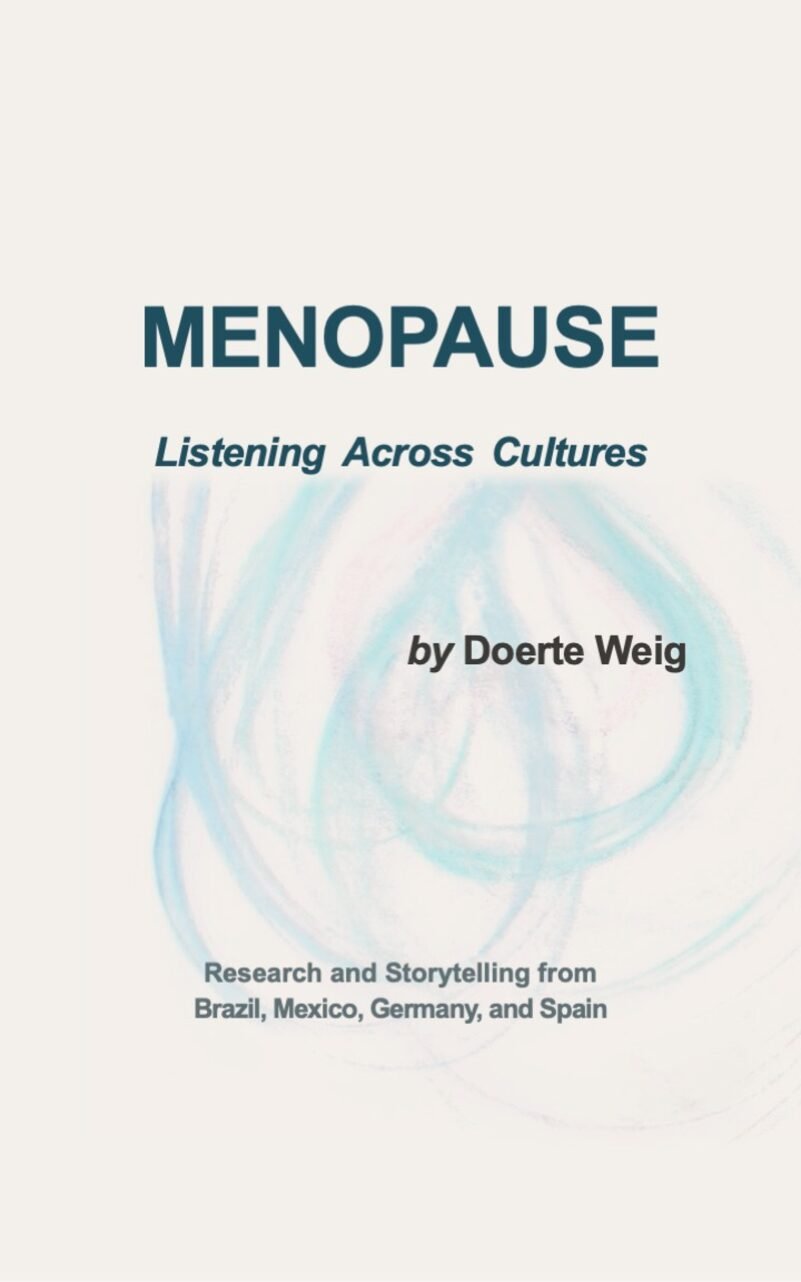
English Edition
German Edition
Menopause - Zuhören zwischen Kulturen (German Abstract)
Menopause: Zuhören zwischen Kulturen führt durch Brasilien, Mexiko, Deutschland und Spanien und sammelt Geschichten von Ältesten und Frauen in der Nachbarschaft, und aus Wissenschaft und Kultur, um die Wechseljahre als eine kulturelle Erfahrung zu beleuchten.
Aus über hundert Gesprächen und Workshops – im Gesundheitszentrum in Bahia, bei Begegnungen mit Hebammen in Oaxaca und in Gesprächsrunden in Stuttgart und Barcelona – beschreibt dieses Buch die Wechseljahre als Prozess und Tor, geprägt von Ernährung, Herkunft, Sprache und den Rhythmen der Erde. Es verbindet wissenschaftliche Forschung mit Lebensgeschichten, und zeigt die Wechseljahre als kreatives Feuer statt als Verfall – als ein uraltes Erbe, das uns wieder mit Intuition, Sehnsucht und der Weisheit der Gemeinschaft verbindet.
Bewegend, transformierend und voller Zuversicht – so sieht man die Wechseljahre in einem ganz neuen Licht.
Funders & Collaborators
Stiftung Mensch und Mensch (Foundation Human to Human) Berlin, who co-financed the cross-cultural research into menopause and associated travels to Brazil, Mexico, Germany and Spain for the journalistic reportage, published as ‘Menopause – Listening across Cultures’.
References
text